
INTERVIEW WITH LA REGIÓN
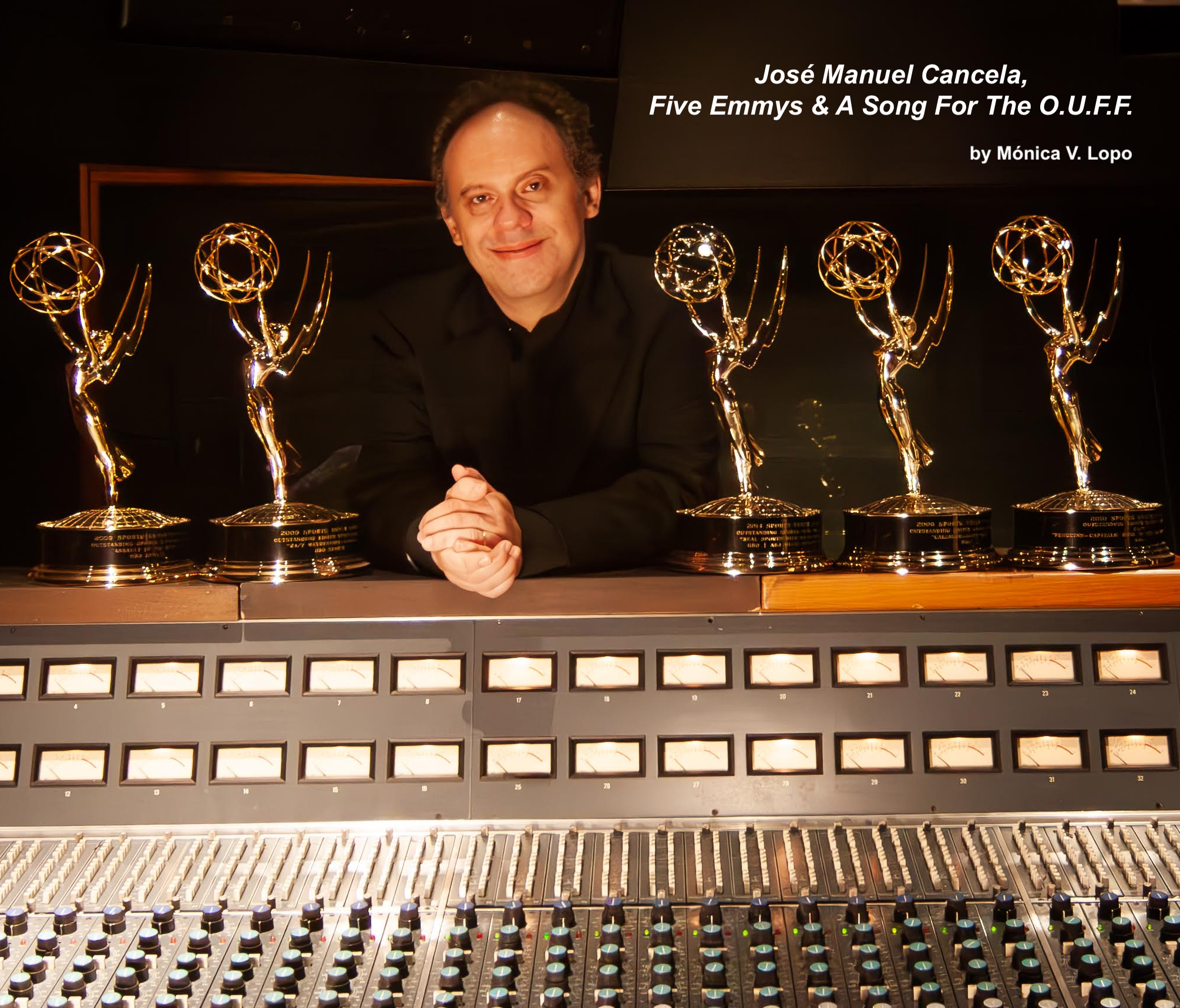
José Manuel Cancela, five Emmys and a song for the O.U.F.F.
José Manuel Cancela's childhood is marked by the sound of the bagpipes that sparked his passion for music. Along the way, a brilliant career took him around the world as a touring musician for Celia Cruz. Later, Janet Jackson, U2, and the Backstreet Boys enlisted his talent to join their musical cast. 9/11 and the fate of falling asleep instead of taking the first plane to crash into one of the Twin Towers led him to put touring on hold and immerse himself in the world of composing soundtracks for films, TV series, video games, and commercials. Five Emmys endorse his career. Behind these dizzying achievements lies the humility, simplicity, and gratitude of a great person who saw his dream fulfilled. We'll soon see him in the city, presenting the song he composed for the Ourense Film Festival, which will be performed by the Xove Orquestra Ourensanía.
Author Mónica V. Lopo
QUESTION: Your professional career is dizzying. But since everything has a beginning, and we all fall in love with the beginnings of stories, tell us yours.
Jose: I was born in Hanover, Germany, the son of Galician immigrants from A Coruña, but every summer we returned on vacation to see family and spend time at the "hogar." On one of those occasions, a bagpipe group was playing in my father's village. When I heard that sound, it felt like I was sticking my fingers in an electrical outlet (laughs). I felt like a current ran through my body. It's hard to explain, but it was as if it lit a flame inside me that never went out. So, at that moment, I began insisting to my parents, like any child would when faced with their most coveted toy, that I wanted to play the bagpipes.
QUESTION: And he did it.
Jose: Well, I was seven at the time, and they thought, given my age, it would be a treat. So first they bought me a toy bagpipe. One of those typical ones sold at souvenir stands that says "Souvenir of Galicia" (laughs). And with it in my luggage, I returned to Hanover. But that wasn't enough, so I kept insisting on the idea that I wanted to play the bagpipes.
QUESTION: But his persistence paid off, and he soon began playing the bagpipes in Germany.
ANSWER: In Hanover, there was a Galician bagpipe and dance group at the Galician Center, and I showed up one Sunday. They were much older than me—seven years old—and when they saw me appear with the toy bagpipe... I think I stirred a great affection for them. So Jaime Pardo and Ovidio Quintela, leaders of the Os da Ría group, with all their professionalism, gave me one of the bagpipes, one of the "real" ones. I remember it was three times bigger than me, and I was rather small. But they decided I could start learning to play the flute. They taught me, and six weeks later I was giving my first performance.
QUESTION: That is having a gift.
ANSWER: Everything has an impact. I had the ear, the desire, and the eagerness to learn. So much so that my parents had to endure hours and hours of rehearsals at home. I don't know how they didn't go crazy with so much "noise" day and night.
QUESTION: It's somewhat poetic that it was the bagpipe that sparked his interest in music, not a guitar or a piano, for example.
ANSWER: The depth of the earth's roots. I was born in Germany, but Galician blood runs through my DNA, so I guess it couldn't be any other way.
QUESTION: And the time came for more formal training.
ANSWER: A few months after that first performance, the music teacher at the school I attended called my parents for a meeting. He told them there was no doubt I had a very good ear and that it might be a good idea to pursue a future in that field. And for that, I have to thank my parents, wherever they are, for their 1000% support. They got me an instrument, paid for lessons, were flexible so I could practice at all hours, took me to concerts—everything so I could immerse myself in everything related to music. I think they knew very well that if you want to succeed in that world, you have to be very good. Not good. Very good. They made a huge effort. And that was the main reason I advanced so quickly.
I began studying piano, the classical repertoire of great musical masters, especially German composers. At the same time, at 17, I also began studying jazz and playing in a flamenco pop group. I played with them on weekends in different cities and discovered what it was like to be a professional musician.
When I was about to finish my studies, my piano teacher told my parents that he couldn't teach me any more, but that it was worth it for me to continue my path in the world of music. That I still had a lot to learn and that I would be capable of giving much more. He suggested I go to Boston, to the prestigious Berklee College of Music. I'd never heard of that place in my life. But my father believed in me and in that opportunity. So, in 1994, I packed my bags and began a new chapter as a Berklee student.
QUESTION: What a change!
ANSWER: That was incredible. Imagine! Suddenly I found myself surrounded by people who were just as crazy about music as I was. It was fascinating! I worked really hard to finish the race in record time.
QUESTION: At just 23 years old, a call changed everything again.
ANSWER: I was experimenting with rhythms, searching for the musical style I felt most comfortable with, when a friend—a professor of Latin music—offered me to audition in New York for him. When I asked him what it was, he told me it was tropical music. I had a basic understanding of that style, but what I did know was how to read any sheet music, thanks to my training. So I jumped at the chance and went to the audition. Once it was over, the manager at Sony asked me to come to his office; there was someone there who wanted to meet me. When I walked through the door, I ran into a Cuban man over 2 meters tall, impeccably dressed. I had no idea who he was. He asked me if I wanted to work, to which I undoubtedly said, "Sure!" At that point, he also wanted to know if I recognized him.
He told me he was Pedro Knight. I still didn't get it, as if he'd told me any other name. "Maybe you know who my wife is. My wife is Celia Cruz." So I was standing before the trumpet player and manager of the "queen of salsa." I took the test, and that same weekend I began touring around the world with Celia Cruz and her group.
QUESTION: If you never know…
ANSWER: The funny thing is, when I was little and on the "tacatá," my favorite babysitter was the record player. And the thing that played the most was a Celia Cruz vinyl my parents had.
QUESTION: I don't know if you could tell us what it was like working with a legend like Celia Cruz.
ANSWER: I was very fortunate because Celia Cruz was a great teacher for me in everything. Not just in how to be a great artist or how to act, but in how to be a person. Humility was one of her main virtues. She was always one of the herd. She didn't stand out. She was like any of us. And an inexhaustible source of joy.
He taught me to be a professional, to get up on stage even if the world had collapsed around your head, because there were people waiting for you to give them a moment of joy.
And I can't overlook how much Celia Cruz took care of me. I'm referring to the aspect of ensuring that I didn't fall into the "darkest" part of the music world. It's a fine line where you can trip and fall on the wrong side at any moment. When you're on stage, watching thousands of people vibrate with you, you have to keep your head on straight so that when you get off, you don't stray and lose your way. She taught me so many things...
QUESTION: A thousand and one lessons learned, and I suppose a thousand and one anecdotes.
ANSWER: There were so many concerts. To name one, I remember the Maracanã Stadium in Rio de Janeiro, with more than 120,000 people in the stadium. They had even declared a state of emergency in the city and called in the army. Or in Japan, where I was completely unaware that Celia Cruz was so adored. At one of the concerts in that country, I remember her calling a young man up on stage, "my great friend Hiro, the voice of Cuba." So, we see a Japanese man come up, with typical Japanese features, and when he takes the microphone, you hear him sing in perfect Cuban. Like the most Cuban of Cubans (laughs). We were all impressed and disoriented. It was like closing our eyes and hearing something that, when you saw it, didn't match the image. The explanation was that his father was Cuban and he had grown up in Cuba.
QUESTION: He wasn't just a touring musician with Celia Cruz.
ANSWER: I also played with artists like U2, Backstreet Boys, Janet Jackson and Chick Corea.
QUESTION: After traveling the world, you took a turn in your life by dedicating yourself to composing. What led you to this?
ANSWER: 9/11. That fateful date that needs no further explanation. The attacks on the Twin Towers on September 11, 2001. I was on tour and had to catch a flight to Los Angeles. For reasons I still don't understand to this day, I fell asleep. I fell asleep and couldn't catch the plane. The plane that crashed into one of the Twin Towers. The first tower. Four hours passed during which people, my people, thought I was dead. Many of my colleagues died that day—a story he tells in a whisper, his emotion still lingering. That fear, that feeling that the world was changing, made me realize I wanted something else.
My Berklee classmate was a composer, and at the time he was working on the soundtrack for a series about doctors, with some drama, comedy, romance... which ended up being "Grey's Anatomy." And by watching him so much, I was able to see how he worked when composing for something audiovisual.
QUESTION: What was your first job as a composer?
ANSWER: An advertising spot for the “Gatorade” brand.
QUESTION: I understand that the sensations were good.
ANSWER: I felt very comfortable and fell in love with the moment when music and image join hands, perfectly aligned. So I decided to delve deeper and study composition for audiovisuals.
QUESTION: How would you define the importance of music in audiovisuals?
ANSWER: I think, personally, an actor can say a lot with his dialogue, a look, or a gesture; a cameraman can perfectly capture the dynamics, the landscape, the action... but I think composers, in a way, pull the emotional strings. I believe that if we do our job correctly, we make the viewer lose themselves in the experience, forget reality for a moment, and allow themselves to be drawn into the story they're watching.
QUESTION: You've provided soundtracks for TV shows, movies, video games, and commercials. Is there anything you can tell us about as a reference?
ANSWER: The opportunity that launched me into the world was the documentary "Rize" (2005), which showcases the phenomenon of "krumping," a dance that emerged on the streets of South Central Los Angeles. A friend was working on it, and I offered to do the soundtrack because it seemed so human to me. Seeing kids, in an area with high crime rates, having dance battles to combat this problem.
After that… for the program “Gordon Ramsay: Off the Menu,” featuring the prestigious chef who collaborates to transform businesses in crisis; the series “Hanna Montana” starring Miley Cyrus; the films “Focus: Masters of the Swindle” starring Will Smith and Margot Robbie; “Creed: The Legend of Rocky”; the documentary “Hala Madrid”; for the documentary series “The Last Narc” about the 1985 death of American DEA agent Enrique Camarena; the video game “The Matrix: Path of Neo”…
QUESTION: I guess on a personal level it's very satisfying.
ANSWER: I think the moments when a creative, a producer, a director, tells you, "I'm leaving it in your hands. Do the soundtrack for this project." In that moment when they let you try and experiment, drawing on your background, even if you fail when you see the idea in the image, you know you've done things right. I've worked with many people who have given me that freedom, that opportunity, that chance to seek a new perspective on how to approach the emotions of love, tension, horror, drama... any dynamic that can be captured in film. That's been very satisfying: being able to work in a place where you can bring a new perspective.
QUESTION: And the awards arrived. No less than five Emmys. Who would have thought that the kid who brought home a toy bagpipe as a souvenir to quell his urge to play!
ANSWER: I never imagined it. Like all artists, I suffer from "imposter syndrome." Sometimes I struggle to understand how I got here. I think, at some point, I must have found the right melody, with the right accompaniment, at the right time, with the right program, with the right film... and that's how my journey unfolded.
I fully understand that there are composers much better than me who haven't had these opportunities. So, I often think it's a result of being in the right place, at the right time, with the right people. I consider myself very lucky.
QUESTION: What is the most difficult thing about composing?
ANSWER: Giving a new perspective to an emotion. We are tied to 12 musical notes. Notes that have been the same for thousands of years. It's up to us to interpret something with a new perspective, a new melody, a new accompaniment, a new style... A new way of approaching themes that are older than time. We have to say something new and fresh with something that already exists.
QUESTION: The creation process must be very intense.
ANSWER: It's a lot of hours of dedication and work. So I have to take this opportunity to thank the support of two very important people in my career: my partner, Begoña, and my son, Mateu. They are my sources of inspiration and my pillars. It's very nice to tell it this way, seeing the career, the awards, the successes... but what people don't see is that the creative, in my opinion, lives in a triangle between madness, paranoia, and fear. The madness of having just come up with an idea and having to immortalize it immediately. Even though the food is on the table and the in-laws are waiting (laughs); the paranoia of not forgetting the idea because it's a good one; and the fear of "what if I wake up tomorrow and the idea is stupid?" And that happens day after day. And people don't see the chaos that the people who live with us have to endure. So I have to thank my partner and my son for being there with their infinite patience.
QUESTION: Do you reveal Galician DNA in your creations?
ANSWER: If I see a little space, I quickly include the Galician sound wherever I can (laughs). The tambourine, the bagpipe, the scallop shell," he says, picking up a shell he has on hand in his Los Angeles studio. "I admit that I often include sounds without people being fully aware of it."
People are always impressed by those "rare" instruments, which they don't usually see in everyday life. And I tell them it's "the secret ingredient." Sometimes they ask me what that instrument is, and I tell them, "Don't worry, it's fine right there where it is" (laughs).
QUESTION: When is a composition finished for you?
ANSWER: Never! (laughs). What saves me are the deadlines; otherwise, I'd be going around in circles forever. I'm a perfectionist. But the beauty of music is that it's always evolving. And what I once composed, 20 years ago, I now realize I'd do differently.
QUESTION: Speaking of creations, and bringing us closer to Ourense, there is the composition of this year's theme for the Ourense Film Festival.
ANSWER: I was in contact with Óscar Doviso and Marcos Vázquez, the artistic and technical directors of the OUFF, respectively, through a previous project. When they took over as directors of the Festival, they suggested I create a new main theme. And I didn't hesitate.
They gave me very clear and detailed guidelines when it came to conveying their vision. They wanted a work reminiscent of old-fashioned cinema. Those experiences in the movie theater from when we were kids, enjoying the experience of watching a movie on the big screen in a theater, without distractions. With that in mind, I composed the song, and now all that's left is to wait for the premiere.
QUESTION: We will find out on September 28th.
ANSWER: That day, I'll be conducting the Xove Orquestra Ourensanía (Ourensania Young Orchestra) in a performance of the piece at the Auditorium. However, there will be a small preview of the opening session on Friday, the 26th.
QUESTION: A good excuse to visit Galicia and Ourense.
ANSWER: Very good! Although there isn't a year that goes by that we don't take a trip to Galicia. Living in Los Angeles is like living in fifth gear. Arriving in Galicia is like shifting into second gear. And I think that's something very necessary. Enjoying time calmly, with a good conversation, a meal with a long after-dinner conversation, greeting neighbors, visiting places without looking at the clock... I think it's much healthier for both body and mind. Living a little more slowly.
QUESTION: Can you tell us about any short-term projects?
ANSWER: I'm working on the soundtrack for a romantic comedy to be shot in Oaxaca, Mexico. It will be my first romantic comedy, in which I'll have to fuse traditional Mexican music with the Galician Symphony Orchestra. A challenge.
QUESTION: Finally, because it's necessary to put a final point to the interview, what lessons would you share from your career and experience?
ANSWER: If you have a dream, have the courage to fight for it. It doesn't matter what the dream is. Maybe you're the next Messi. Or the next Salvador Dalí. Or Isabel Allende's successor. The next Alberto Iglesias. No matter the dream. But have the courage to fight and accept the sacrifices and ups and downs you're going through to achieve it. That has been the great lesson I've learned throughout my life and that I plan to pass on in the third part of my life: the first was learning, the second was executing, and the third was giving back. And that's one of my dreams. To give back everything I've learned to my homeland and my country so that, once I'm gone, Spanish music and composers will continue to leave their mark.